
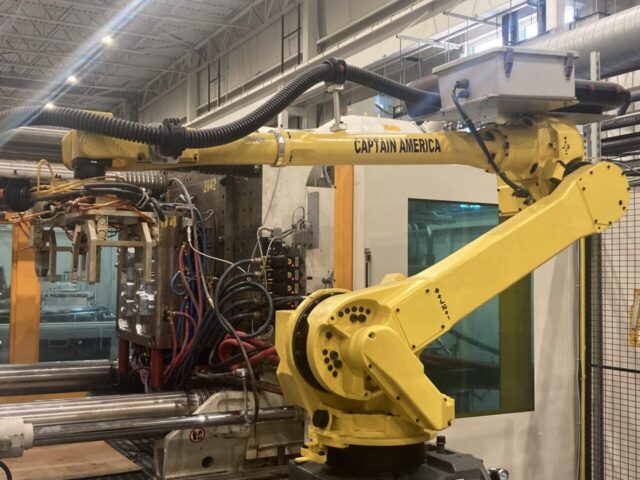
I had the chance to visit United States supporting production plants on robotics and automation topics.
I came with the usual mindset—expecting to solve problems, step in where needed, and maybe teach a few things along the way…
That’s something I’ve done in many locations throughout Europe: connecting mechanical, electrical, and software elements. The one who gets called when things get tough.
But in the U.S., something unexpected happened.
I Met People Who Already Think Like I Do
I met technicians and engineers who genuinely impressed me.
And that’s not something I say lightly.
They weren’t just wiring cabinets or writing PLC code—they were operating across the full spectrum: robotics, sensors, logic, motion, safety, integration. They didn’t specialize in just one corner—they owned the whole system.
In the U.S., I saw something I rarely encounter in Europe: people who had grown into full-stack integrators, not through formal instruction, but out of necessity and mindset. In lean environments, they simply had to solve problems across multiple layers—and they were fast, confident, and competent.
For the first time in a long while, I didn’t feel superior.
I met people who were… like me.
The Impostor Voice Came Back — But It Felt Different
I’ve battled impostor syndrome for most of my career.
Even with years of solid results, the voice inside often told me I didn’t truly deserve the title printed on my badge—Process Specialist, Robotics Expert, or whatever label was used that day.
And here in the U.S., that voice returned—louder than usual.
Surrounded by people so skilled and capable, I felt… ordinary.
Not “the guy who fixes everything.” Not the standout.
But this time, that feeling didn’t hurt.
Because it wasn’t rooted in self-doubt—it was rooted in respect.
What I saw wasn’t competition—it was recognition.
People who operate at the same wavelength, without titles or hierarchy, just grounded skill and shared logic.
Challenging a Common European Assumption
What struck me even more was how this experience challenged a very common stereotype I’ve heard across Europe:
That U.S. education is weak in general. This could lead to the conclusion that American technicians lack depth.
But what I saw was the opposite.
I saw hands-on skill, real-time problem-solving, and deep system understanding—the kind that isn’t taught in theory only, but earned through experience. These people weren’t quoting textbooks. They were making things work.
Meanwhile, in many European plants—especially in Eastern Europe—I often see the opposite pattern:
Engineers in title, but not always in mindset.
Too many graduate without curiosity.
They hold outdated theories, rarely applied in real-life manufacturing, and show little hunger to grow. Their education was simply a means to get the title—not a tool to build understanding.
That may sound harsh, but it’s my honest experience.
The Maker vs. The Paper Engineer
The difference isn’t just the person—it’s the system:
- In the U.S., engineers are often forged in real factories, small teams, lean setups. They grow from solving problems directly.
- In Europe, many are trained as specialists—then boxed into rigid roles. If something breaks outside their scope, they wait for someone else.
The result? In the U.S., I saw integration as instinct. In Europe, it’s often bureaucracy.
Recognition, Not Comparison
This isn’t about disrespecting anyone. Europe has brilliant minds, no doubt.
But we need to be honest about what truly matters in today’s industry:
Curiosity. Adaptability. Integration. Results.
And for me, meeting people who naturally embody those qualities—rather than just carry a title—was refreshing.
It reminded me that I’m not alone in how I think.
I’m not the only one trying to connect systems, break silos, and see the bigger picture.
Others out there have been shaped the same way—by necessity, by curiosity, by action.
And sometimes, recognition is more important than superiority.
I’m thankful I felt it.